Ifa Divination
Ifa
Ifa is at once a system of divination, a vast corpus of oral literature, and the philosophical and ethical foundation of Yoruba religion. Recognised by UNESCO as an Intangible Cultural Heritage of Humanity, it is arguably the most complex indigenous knowledge system in Africa — a living archive of poetry, history, medicine, law, and theology that has been transmitted orally across centuries and is still actively consulted today.
What Ifa Is
Ifa is both a body of knowledge and a practice. The knowledge is the Odu Ifa — 256 primary chapters, each associated with a specific configuration of the divination apparatus, each containing hundreds of narrative poems (ese Ifa) dealing with every aspect of human and divine life . The practice is the consultation: a client comes to a Babalawo (divination priest, literally 'father of secrets') with a question, the Babalawo casts the divination system, identifies the relevant Odu, and recites the appropriate ese to guide the client's understanding and decision.
The scale of the corpus is staggering. Each of the 256 Odu contains many individual ese — some estimates put the total number of individual poems in the hundreds of thousands. A single Babalawo may know only a portion of this total; true mastery requires a lifetime of study. The corpus functions as something like a cultural encyclopedia: within it, one can find accounts of the origins of the orishas, instructions for healing specific ailments, guidance on agriculture, relationships, and governance, and the philosophical framework through which Yoruba people understand the human condition.

UNESCO Recognition
“In 2005, UNESCO inscribed Ifa divination on its List of Intangible Cultural Heritage of Humanity, recognising it as a living tradition of outstanding universal value — active across Yorubaland and in diaspora communities across the Americas.”
Orunmila: The Deity of Wisdom
In Yoruba theology, Ifa is inseparable from Orunmila — the orisha of wisdom, knowledge, and divination . Orunmila is said to have been present at the creation of individual human beings, witnessing each person's destiny (ori) before birth. This witness makes him uniquely qualified to advise humans on their path through life: he knows what was decided before birth, and through Ifa, humans can access this knowledge.
Orunmila is also known as Ela, and there are complex theological traditions about his nature — whether he is to be understood as a deified ancestor (a great diviner who lived on earth), a primordial spiritual force, or both simultaneously. In practice, Babalawo approach Orunmila as an intermediary — a divine consultant whose knowledge encompasses both the visible world and the spiritual realm (Orun).
Unlike many orisha who are associated with specific natural forces, Orunmila’s domain is epistemic rather than elemental. He governs wisdom itself — the structure of knowledge that makes reality intelligible. His authority rests not on physical power but on insight. In this sense, Orunmila represents the principle that the universe is patterned and meaningful, not chaotic. Through disciplined divination, those patterns can be discerned.
Central to Orunmila’s role is his relationship to ori, the inner spiritual head that carries a person’s destiny. Yoruba theology holds that individuals choose their ori before birth in the presence of the Supreme Being. Orunmila, as witness to this pre-birth choice, possesses unique insight into each person’s life trajectory. However, destiny in this framework is not rigid fatalism. Ifa consultation reveals tendencies, imbalances, or neglected obligations, and prescribes corrective actions (ebo) to restore alignment. Thus, Orunmila’s wisdom is practical and restorative rather than merely predictive.
The teachings attributed to Orunmila are preserved in the vast corpus of Odu Ifa — a structured body of divinatory signs and accompanying verses. These verses contain myth, philosophy, ethics, medicine, history, and social instruction. Through them, Orunmila is understood not only as a spiritual force but as custodian of an intellectual tradition. The training of a Babalawo requires memorization, interpretive skill, and moral discipline, reflecting the depth and rigor associated with Orunmila’s knowledge.
Theologically, Orunmila occupies a distinctive mediating role. He is closely associated with the Supreme Being yet remains accessible to humans through ritual consultation. He bridges divine intention and human decision-making, revealing the underlying moral and spiritual dimensions of everyday life.
In devotional practice, Orunmila is approached with reverence, humility, and trust. He is praised as patient, truthful, and impartial — one who speaks clarity into confusion. His wisdom is not coercive; it guides rather than compels. Through Ifa, devotees seek not only answers but understanding — an alignment of thought, character, and destiny with the deeper order of the cosmos.
The Mechanics of Divination
Ifa divination uses two primary instruments: the ikin (palm nuts) and the opele (a divining chain of eight half-shells or seed pods). The Babalawo casts these to generate one of 256 possible configurations — the Odu . With the ikin, the process involves rapidly passing 16 palm nuts from one hand to the other, checking whether one or two remain, and recording the result in a pattern of marks traced in a tray dusted with sacred powder (opon Ifa). With the opele, the chain is cast and the pattern of concave or convex faces on each of the eight elements is read directly. Ifa divination uses two primary instruments: the ikin (consecrated palm nuts) and the opele (a divining chain of eight linked segments). Both are designed to generate one of 256 possible configurations known as the Odu , which form the structural foundation of the Ifa corpus.
With the ikin, the Babalawo works with sixteen sacred palm nuts that have undergone ritual consecration. Holding all sixteen in one hand, the diviner attempts to grasp and transfer them quickly to the other hand. After each transfer, the number of nuts remaining in the original hand is checked. If one nut remains, a double vertical mark is inscribed; if two remain, a single mark is inscribed. These marks are traced into sacred powder (iyerosun) spread across the surface of the opon Ifa (divination tray). The operation is repeated eight times, producing a full binary pattern of marks. This pattern corresponds to one of the sixteen principal Odu; when understood in upper and lower pairings, it situates the consultation within the complete set of 256 possible signs.
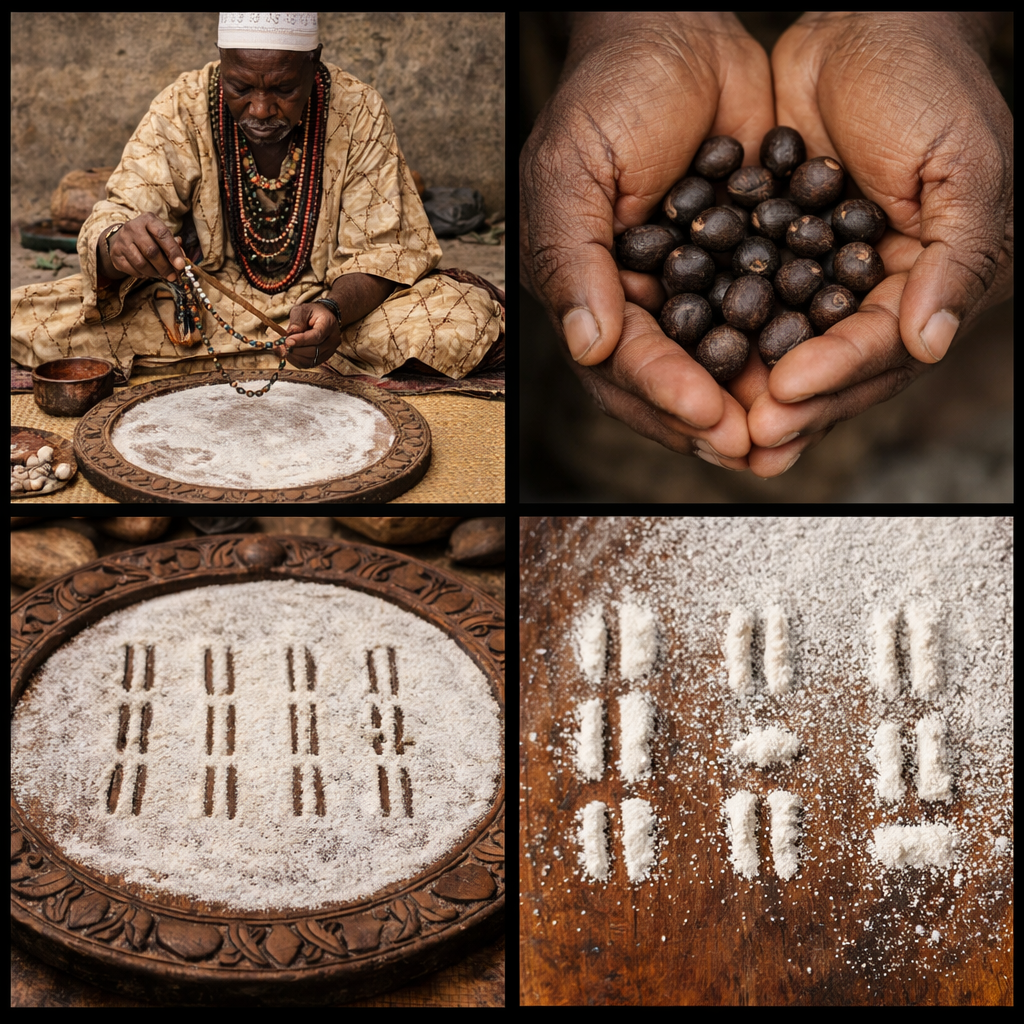
The opele provides a faster mechanical method while producing the same range of outcomes. The chain consists of eight segments, each capable of landing in one of two orientations when cast — concave or convex. When the Babalawo casts the chain, the visible orientation of each segment is read in sequence, forming an eight-part pattern equivalent to the marks generated with the ikin. Though more rapid, the opele does not simplify the system; it encodes the same combinatorial structure in a different physical form.
The opon Ifa serves as the ritual surface for recording and reading these patterns. Typically carved with symbolic imagery — often including Esu at the top border — the tray’s center is dusted with iyerosun, allowing the marks to be clearly inscribed and visible. The physical act of marking transforms abstract possibility into visible configuration, grounding the mechanical process within sacred space.
Once the configuration is produced, the resulting Odu is identified by name — Ogbe, Oyeku, Iwori, Odi, and so on through all 256 permutations. The mechanical phase ends here. The Babalawo then recites relevant ese Ifa (verses) from that Odu, interprets them in light of the client’s question, and may prescribe ritual offerings (ebo) to activate favorable outcomes or avert potential imbalance.
The mechanics of Ifa divination thus combine disciplined physical procedure, binary combinatorial structure, sacred inscription, and oral recitation into a unified system. The casting of palm nuts or chain is not arbitrary; it is the ordered method through which the Odu — and the wisdom embedded within them — are revealed.
The sequence of actions — casting, marking, naming, reciting — follows a disciplined logic. Each step narrows possibility into pattern. The eight-part structure of the Odu reflects a binary system in which single and double marks combine into sixteen principal signs, which then pair to form the full 256 configurations. This mathematical order is not incidental; it undergirds the reliability of the system. The mechanical generation of the sign ensures that the consultation emerges from structured procedure rather than subjective choice.
At the same time, the process is not mechanistic in a reductive sense. The Babalawo invokes spiritual authority before casting, often through prayer or praise poetry, acknowledging the presence of Orunmila and Esu in opening the channels of communication. The instruments themselves — the ikin, the opele, the opon Ifa — are consecrated objects. Their ritual preparation situates the mechanical act within sacred context.
Once the Odu is identified, the diviner’s training becomes central. Mastery of the Ifa corpus requires memorization of extensive verse traditions and the ability to recognize which narratives correspond to the client’s circumstances. The mechanical sign does not “speak” automatically; it provides the framework within which meaning is articulated. The interpretive act draws from established textual tradition rather than spontaneous invention.
If ritual action (ebo) is prescribed, it is tied directly to the logic of the revealed Odu. The materials, timing, and intent of the offering correspond to the narrative precedent contained in the verse. In this way, the mechanical generation of the sign leads to practical prescription. Diagnosis and remedy are structurally linked.
The mechanics of Ifa divination therefore represent a fusion of combinatorial structure, embodied technique, ritual inscription, and disciplined oral transmission. The physical casting produces form; the named Odu situates that form within a vast archive of meaning; the recited verse interprets it; and prescribed action extends it into lived reality. Through this ordered sequence, the consultation becomes a structured encounter between pattern and person, cosmos and circumstance.
Odu
256
The number of primary Odu (chapters) in the Ifa corpus — the complete range of divination signs.
Ese
600+
Estimated minimum ese (verses) per Odu — the literary content that gives each sign its meaning.
Training
Years
A Babalawo's training traditionally begins in childhood and continues throughout adult life.
Ifa in the Diaspora
Ifa did not remain confined to Yorubaland. Enslaved Yoruba people carried the tradition across the Atlantic, where it was preserved, sometimes in transformed forms, in Cuba, Brazil, Trinidad, and elsewhere . In Cuba, Ifa was maintained within the Lucumí community and is known as Ifá or the Regla de Ifá. It is distinct from, but related to, the broader Santería religious complex. In Brazil, elements of Ifa survive within Candomblé houses, though often integrated into wider ritual systems.
In these diasporic contexts, Ifa developed in dialogue with Catholicism and local spiritual traditions. During the colonial period, sacred practices were sometimes concealed within Catholic symbolism or ritual calendars as a strategy of survival. Despite adaptation, core elements remained consistent. Devotion to Orunmila, recognition of the Odu corpus, initiation lineages, and the centrality of divination continued to define the tradition.
Cuba became a particularly significant center for the preservation of Ifa priesthood lineages. Lucumí Babalawo maintained structured training systems and transmitted large bodies of verse traditions across generations. Brazilian Candomblé communities preserved reverence for Orunmila, though divination methods sometimes emphasized other ritual instruments alongside Ifa. Across the Caribbean and the Americas, Ifa survived as a living practice rather than a symbolic remnant.
In the twentieth and twenty-first centuries, Ifa has experienced a global revival. Practitioners in North America, Europe, and the Caribbean have sought initiation through Yoruba Babalawo in Nigeria and in established diasporic communities. International associations have formed to promote ethical standards, preserve lineage integrity, and encourage scholarly engagement with the tradition.
Ile-Ife remains widely regarded as the spiritual center of Ifa. The Araba Awo of Ife, recognized as the head of the Ifa priesthood, holds a position of significant authority within the tradition. At the same time, the practice now spans continents. Initiations occur in Lagos, Havana, Miami, London, and São Paulo. Conferences, academic research, and digital communication have strengthened transnational networks while also prompting debates about authenticity, adaptation, and continuity.
Today, Ifa exists simultaneously as ancestral heritage, organized priestly tradition, and global religious movement. Its journey through the Atlantic world demonstrates both resilience and transformation. Rooted in Yorubaland, shaped by displacement, and sustained through disciplined transmission, Ifa continues to function as a living system of divination, theology, and communal identity across diverse cultural landscapes.
References
- [1]
Abimbola, W. (1976). Ifa: An Exposition of Ifa Literary Corpus. Oxford University Press, Ibadan.
- [2]
Bascom, W. (1969). Ifa Divination: Communication Between Gods and Men in West Africa. Indiana University Press, Bloomington.
Related Entries